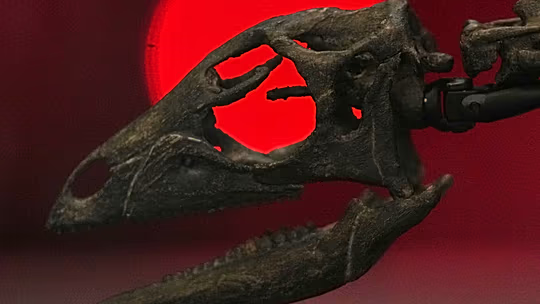
NOW OPEN: London's Natural History Museum Unveils 'Jurassic Oceans: Monsters of the Deep'
London’s Natural History Museum (NHM) has officially launched its highly anticipated blockbuster exhibition, "Jurassic Oceans: Monsters of the Deep." Supported by the Blavatnik Family Foundation, this immersive experience transports visitors nearly 200 million years into the past, back to an era when terrifying marine reptiles and colossal apex predators ruled the global waves while dinosaurs dominated the land.
Unlike the museum's historic, static dinosaur galleries, this temporary exhibition pairs world-class paleontology collections with slick digital films, interactive 3D-printed sculptures, and unique tactile stations where visitors can touch genuine fossils.
"Experience the Jurassic like never before in this thrilling encounter with ancient ocean giants, where danger is lurking behind every corner, and predators quickly turn into prey." — Dr. Marc E.H. Jones, Lead Science Curator
? Meet the Stars of the Prehistoric Deep
The exhibition highlights the bizarre, wildly successful evolutionary paths of Mesozoic marine life, showcasing creatures completely unlike anything swimming in our modern oceans:
- The Ichthyosaurs: Massive, dolphin-shaped reptiles that grew up to 25 meters long (comparable to the museum's iconic *Dippy the Diplodocus*). They possessed enormous eye sockets to scour the pitch-black ocean depths for food. Visitors can touch a massive cast of an ichthyosaur skull.
- The Plesiosaurs: Elite predators featuring an evolutionary design never seen before or since—a incredibly long neck paired with four massive wing-like flippers used to "fly" through the water. The exhibition’s centerpiece is a complete, 23-foot plesiosaur skeleton showing clear bite marks where prehistoric sharks scavenged its bones after death.
- The Mosasaurs (The 'T. Rex of the Sea'): Diving into the Cretaceous era, visitors come face-to-face with these terrifying titans. Armed with double-jointed jaws and two rows of razor-sharp teeth built for ripping flesh, they routinely swallowed large fish completely whole.
- Leedsichthys: A gargantuan, whale-shark-sized prehistoric fish that filtered the ancient currents alongside giant squid tentacles and beautifully preserved ammonites.
? A Stark Warning From a Warmer, Wetter Past
Beyond the "wow-factor" of the giant fossils, the Natural History Museum is using the exhibition to tell a critical environmental story. Scientists point out that during the Jurassic period, the planet was significantly warmer and more humid due to staggering levels of greenhouse gases in the atmosphere, leaving the poles entirely free of permanent ice caps.
By analyzing how ancient marine ecosystems reacted to rapid shifts in water temperatures and carbon levels—which ultimately triggered devastating mass extinctions—NHM researchers emphasize that studying these ancient ocean giants is key to understanding, predicting, and protecting our modern oceans against today's accelerating climate crisis.


Comments (0)
Be the first to comment on this story.