
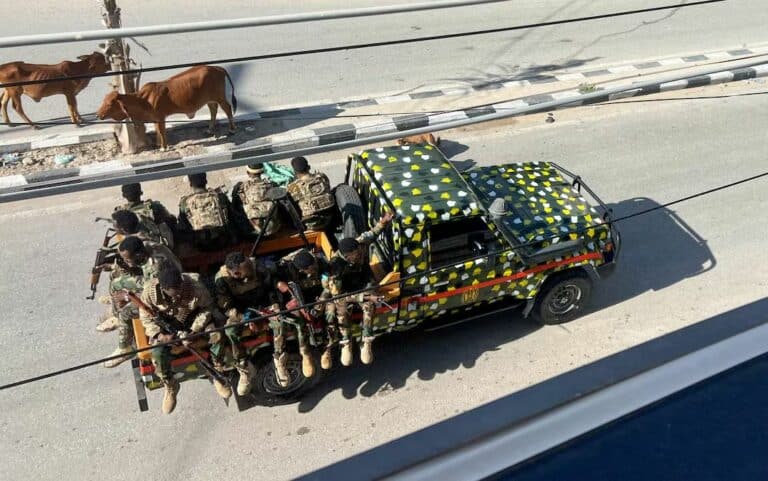
MOGADISHU CALM RESTORED: Somalia Claims Victory Over Opposition Militias Following Fierce 48-Hour Constitutional Battle
The Federal Government of Somalia has officially declared that state security units have fully restored order across the capital city of Mogadishu, following more than 48 hours of intense heavy weaponry exchanges between loyalist forces and armed militias aligned with opposition political figures.
The violent escalation—the deadliest political gridlock to paralyze the capital in years—was directly ignited by a deep-seated constitutional standoff over President Hassan Sheikh Mohamud’s controversial decision to maintain power following the formal expiration of his presidential term.
"Opposition group militias have been disarmed and removed, and civilians have returned to their daily lives."
— Somalia Ministry of Information, Culture and Tourism
? The Trigger: A Constitutional and Electoral Breakdown
The immediate catalyst for the sudden urban combat was a series of planned, large-scale anti-government street demonstrations organized by a united front of opposition leaders.
- The Term Extension Pivot: Political tensions hit a boiling point after President Hassan Sheikh Mohamud remained in office beyond the official May 15 expiration of his mandate. The extension was enabled by a series of contentious constitutional modifications pushed through parliament back in March, which delayed the national election cycle by up to a year.
- The Opposition Revolt: Prominent opposition figures, including former President Sharif Sheikh Ahmed and former Prime Minister Hassan Ali Khaire, vehemently rejected the extension as an illegal power grab, mobilizing heavily armed, clan-backed security elements into their residential strongholds across the capital.
? 48 Hours of Urban Warfare: Heavy Weapons in Densely Populated Zones
What began as public demonstrations quickly disintegrated into active combat, turning several Mogadishu neighborhoods, including flashpoint sectors in Hawlwadag and Abdiaziz, into live frontlines. Heavy bursts of gunfire and rocket-propelled grenades tore through residential sectors, damaging civilian infrastructure and trapping families in their homes.
Former Prime Minister Khaire and former President Ahmed aggressively accused the federal administration of deploying elite, counter-terrorism tactical units—originally trained and equipped by international partners to fight the al-Shabab extremist insurgency—to encircle and assault their private residences using heavy tactical assets, anti-tank weapon systems, and military drones. The government directly countered this narrative, stating its forces were executing targeted security operations to neutralize unauthorized insurgent groups attacking state police units.
? The Human Toll and Fractured Displacement
The sudden explosion of urban warfare left a harsh humanitarian footprint across the capital before the weapons were successfully silenced:
| Disruption Metric | Impact Assessment | Data Source |
|---|---|---|
| Casualties | At least 13 fatalities and 189 wounded civilians | UN Refugee Agency (UNHCR) |
| Displacement | Approximately 12,500 households forced to flee flashpoints | UNHCR Field Monitors |
| Commercial Impact | Total paralyzed lockdown of the Bakara Market trading grid | Mogadishu Merchant Guilds |
? How the Guns Were Silenced: The Elder-Led Truce
While official state portals published statements declaring that opposition fighters had been completely disarmed, local elders and independent security experts on the ground verified that a physical disarmament did not take place. Instead, the heavy fighting ground to a halt following intense, high-stakes community mediation.
The crucial breakthrough occurred after the director of the National Intelligence and Security Agency (NISA) led an emergency delegation to meet directly with opposition leaders and traditional clan heads. The resulting truce brokered the immediate cessation of hostilities and forced the physical withdrawal of both federal troops and opposition combatants from central residential streets, allowing transit lines to gradually reopen.
While relative calm has returned to Mogadishu, international partners—including the United Nations and the United States Embassy—remain highly alarmed, urging all sides to abandon reckless escalations and return to an inclusive, multi-party dialogue before the political instability completely derails the country's long-term offensive against al-Shabab.
Comments (0)
Be the first to comment on this story.